We are very proud that our exhibition, “ANZIEHUNGSKRAFT — Solutions for Sustainability in Fashion,” has been awarded the Lions Sustainability Award 2025/26.
The Lions Sustainability Award recognizes individuals and institutions that take responsibility for the future of our planet. Under the motto “Promoting Sustainability Regionally and Globally,” initiatives that make a concrete contribution to the 17 Sustainable Development Goals of the United Nations were highlighted and supported.
The specific, actionable solutions presented at Shakkei were convincing. We would like to thank the 14 guest labels that participated in our exhibition and enriched it with their ideas and concepts!
https://www.shakkei.at/wp-content/uploads/2026/06/IMG_2889-1.jpeg13692076Shakkei-Adminhttps://www.shakkei.at/wp-content/uploads/2026/09/icon-white-300x300.pngShakkei-Admin2026-06-26 16:39:112026-06-26 16:39:11Our exhibition received an award!
Check out the official tour of our exhibition “ANZIEHUNGSKRAFT – Solutions for Sustainability in Fashion” with Shakkei founder Gabriel Baradee.
As a deliberate antithesis to merely identifying problems, the exhibition showcased concrete solutions and explored how fashion can be reimagined. The ideas presented by 14 labels demonstrated that sustainable fashion is not about sacrifice, but rather about creative freedom. The focus here was on concrete examples and actionable strategies.
Four questions guided the discussion and brought solutions for sustainable fashion into focus:
How can fashion be created without waste?
Is the future of fashion digital?
Is competition outdated? Does sustainable fashion require cooperation?
Is clothing more valuable if it is handmade or repaired?
https://www.shakkei.at/wp-content/uploads/2026/06/Bildschirmfoto-2026-06-01-um-16.17.59.png14051084Shakkei-Adminhttps://www.shakkei.at/wp-content/uploads/2026/09/icon-white-300x300.pngShakkei-Admin2026-06-01 16:25:352026-06-01 16:25:35ANZIEHUNGSKRAFT 2026 Virtual Guided Tour through our Exhibition
I have always seen fashion as a way to tell stories — about identity, craftsmanship, and the values that shape our world. But in recent years, I began to feel that storytelling alone wasn’t enough. I wanted to create experiences that didn’t just display sustainable fashion but made people feel its urgency and beauty. That desire led me to the Interaction Design Foundation (IxDF), and what followed was nothing short of a transformation — not only in my creative process but also in my professional identity.
Before IxDF: A Fashion Designer Seeking Deeper Engagement
As the founder of Shakkei, a sustainable fashion label and design store based in Vienna, I had long been focused on zero-waste design and ethical production. My collections reflected my values, but exhibitions and fashion shows often felt one-sided — a showcase of finished garments rather than an interaction with the audience.
I put on performances and people admired the clothes, but I wanted them to engage — to touch and understand. I strived to convey the resourcefulness and craftsmanship behind zero-waste patterns, and wanted people to rethink their own consumption habits. I realized I wasn’t just designing clothes anymore; I was designing experiences. But I lacked a structured approach to build those experiences effectively. That’s when I discovered the Interaction Design Foundation.
Learning to Think Like a UX Designer
IxDF’s courses on User Experience Design, Gamification and Psychology of Interaction Design opened an entirely new dimension of creativity for me. The first major shift was mental: I began to think about incorporating UX design into my approach to fashion design.
Fashion designers are trained to think in terms of materials, silhouettes, and emotion. UX designers think in terms of user journeys, motivations, and feedback loops. Once I understood that these perspectives could be merged, my work began to change.
The course “Gamification: Designing for Motivation” in particular became a turning point. It helped me understand how playfulness and curiosity can drive engagement and learning. I started to ask: “What if I applied the same principles that make digital experiences addictive — like rewards, exploration, and storytelling — to a physical fashion exhibition?” That question eventually became the foundation of my next big project.
“Gamification allows consumers to have fun, get useful information & encourages them to share it with their friends.” – Joe Rork, UX Engineer – MyFord Mobile at Ford Motors
The Zero-Waste Exhibition: From Static Display to Interactive Experience
During Fashion Revolution Week, I organized an exhibition at the Shakkei Design Store focused on zero-waste pattern design — a sustainable approach where every piece of fabric is used, leaving no pre-consumer waste behind.
Traditionally, such exhibitions rely on visuals and information boards. But this time, I wanted to design it like a UX journey. I mapped out the visitor’s path through the space, considering their motivations, emotions, and potential “pain points” — just as I had learned in my IxDF courses.
To make the experience interactive, I integrated gamification and digital touch points using QR codes and NFC stickers. Visitors could tap or scan these codes and would be taken to a digital space built specifically for the exhibit.
At the very start of the exhibit, users could unlock a welcome message with a video explaining how the exhibit was conceptualized.
Tapping or scanning unlocked further information about the displayed objects in written, audio and video formats, which also increased the accessibility of our event, catering to visitors who were hard of hearing or deaf as well as those with poor eyesight.
Users could find out more about the history of zero waste pattern construction and gain insight into the modern processes used to create the pieces in front of them. They were invited to learn, touch and explore zero waste fashion through a mix of haptic and digital means.
At the end of their visit, users could fill out a survey, unlocking a thank-you message for engaging deeply with the concept of zero waste and were entered in a physical giveaway.
It wasn’t just an exhibition anymore — it was a game of discovery. Visitors became active participants, moving, scanning, and discussing. What I had once thought of as a fashion presentation turned into an immersive learning experience about sustainability, and users reported back that they enjoyed having a digital way of going back to the exhibit and finding out more about the things that they had learned, even after they had long left the physical space.
Applying IxDF Principles Beyond Digital Screens
What amazed me most was how seamlessly the IxDF frameworks applied to a real-world, offline project. The human-centered mindset, focused on understanding users’ needs, designing for motivation, and creating intuitive interactions, was as relevant in a fashion store as it is in an app interface.
Through this project, I realized that UX isn’t limited to technology. It’s a mindset that can transform any creative process. Whether designing an app, a dress or an exhibition, the goal is the same: to create meaningful connections between people and ideas.
The feedback from visitors was overwhelmingly positive. Many told me it was the first time they truly understood how zero-waste design worked. Others said they felt inspired to rethink their relationship with fashion and consumption. In that moment, I knew that my IxDF learning had achieved something tangible — it had helped bridge the gap between knowledge and experience.
Expanding My Expert Status: From Fashion Design to Experience Design
Before IxDF, I was recognized as a fashion designer with a focus on sustainability. The courses didn’t just enhance my skills; they expanded my professional credibility. Today, I can confidently say that I am also an experience designer — someone who blends aesthetics, storytelling, and human behavior into cohesive, emotionally resonant journeys.
I now collaborate across disciplines, combining UX strategy, gamification, and fashion storytelling to create multi-sensory projects that educate and engage. Clients and collaborators see me not only as a designer but as someone who can build a bridge between digital experiences and physical fashion. This rare perspective sets my work apart.
IxDF gave me the vocabulary, methods, and confidence to position myself as a thought leader at the intersection of fashion, UX, and sustainability. It also connected me with a global community of designers who share a passion for using design as a force for positive change.
Lessons Learned Along the Way
Here are a few key lessons from my journey that might inspire others:
Learning UX can transform any creative career.
You don’t need to be in tech to apply UX principles. Whether you design clothing, exhibitions, or customer experiences, understanding how people think and behave makes your work infinitely more impactful.
Gamification isn’t just about fun — it’s about motivation.
By turning information into an interactive experience, you can make complex or “serious” topics engaging and memorable. Sustainability becomes playful through interaction, not instruction.
Empathy is any designer’s most powerful tool. IxDF’s emphasis on empathy helped me shift from showing what I wanted to communicate toward designing what others wanted to experience.
Small budgets can still create big impact. The zero-waste exhibition had almost no budget. Yet by applying UX thinking, creativity, and digital tools like QR codes, it became one of my most successful projects.
Continuous learning is key to staying relevant.
The fashion industry and the digital world both evolve rapidly. Platforms like IxDF provide the structure, knowledge, and inspiration to keep growing and innovating.
Inspiring Others to Design Experiences That Matter
If there’s one message I want to share, it’s this: the boundaries between creative disciplines are dissolving. Fashion designers, artists, and architects can all benefit from learning UX and gamification. These skills don’t replace creativity — they amplify it.
Through IxDF, I learned that great design isn’t just about beauty — it’s about behavior, interaction, and meaning. My journey from fabric to interface, from pattern to play, is proof that when you blend art with empathy and strategy, you can turn any creative practice into an experience that inspires change.
So, whether you’re a designer, educator, or entrepreneur, wondering if UX can make a difference in your field: my answer is yes. It can change how you see the world, which has a deep impact on how you work.
About the Author
I am a Vienna-based fashion designer, UX designer, and founder of the sustainable fashion label Shakkei. My work focuses on merging design, gamification, and sustainability to create meaningful experiences both online and offline. After completing several courses with the Interaction Design Foundation, I expanded my expertise beyond fashion — into the realm of experience design, where creativity meets human-centered innovation.
https://www.shakkei.at/wp-content/uploads/2025/10/PHOTO-2025-04-28-12-04-46.jpg12001600Shakkei-Adminhttps://www.shakkei.at/wp-content/uploads/2026/09/icon-white-300x300.pngShakkei-Admin2025-10-20 15:54:402025-10-20 16:06:45From Fabric Waste to User Engagement: How IxDF Inspired My Gamified Zero-Waste Fashion Exhibition
Are you interested in fashion and enjoy drawing? Would you like to learn how to illustrate fashion in a practical way? Whether you’ve never had a pencil in your hand before or have been illustrating for a long time – we’ve got you covered right where you need it!
Together with Gabriel Baradee & Evelin Grubbauer you will learn in a small group exactly the tricks & secrets that fashion designers use in everyday life. Whether you are looking for an introduction to the world of fashion illustration or want to learn how to master certain techniques, we will cater to your wishes!
Scheduled dates, each from 10:00 am to 4:30 pm:
COURSE 1: Wednesday, July 2, 2025
COURSE 2: Sunday, July 6, 2025
COURSE 3: Wednesday, July 9, 2025
Price per course:
156€/person (incl. VAT), including course material
(advance payment; can be canceled in full up to 14 days before the date, after that 50% refund)
Zero-Waste Pattern Cutting: Rethinking Fashion from the First Cut
Zero-waste pattern design is a powerful approach in sustainable fashion — it eliminates fabric waste right from the cutting table. Unlike conventional methods where up to 15% of fabric can end up as off-cuts, zero-waste patterns use every centimeter of material, saving resources and reducing production waste before a garment is even sewn.
But while the concept is simple, the execution is complex. Traditional fashion design is rooted in 2D pattern drafting while zero-waste requires a 3D mindset.
This exhibition focuses especially on pre-consumer waste — material discarded before a product reaches the customer, such as leftover rolls of fabric, sample cuts, or off-cuts from production. Through the work of various designers, we showcase diverse zero-waste strategies — from innovative pattern layouts and modular construction to upcycled fabric combinations — all rethinking how fashion can be made with intention and without waste.
Watch our virtual tour through the exhibit here:
https://www.shakkei.at/wp-content/uploads/2025/05/2-Shakkei-ZW-Ausstellung-Shakkei.png8741240Shakkei-Adminhttps://www.shakkei.at/wp-content/uploads/2026/09/icon-white-300x300.pngShakkei-Admin2025-05-02 12:49:172025-05-02 12:51:32Zero Waste Fashion Exhibit at the Shakkei Design Store
Yesterday, I stumbled upon a very old picture of myself at my very first fashion show in Vienna on February 17, 2010. It was a bitterly cold winter day, and Vienna was covered in ice and snow. Back then, I had a tiny budget and very little experience. I was always surprised why sustainability in fashion was not as prominent as it was in the food or cosmetics industries. A journalist even asked me why I wanted to make money while doing something good.
Fast forward to 2025. While researching trouser production, I realized how difficult it is to manufacture a trouser collection in Austria. Production prices are too high, and fewer customers are willing to pay more than €200 for a regular chino.
During my email exchanges with a European production company, I was told that producing fewer than 200 pairs of trousers is considered sampling, making the cost per trouser more than double. This is a common challenge. Similarly, many fabric suppliers have high minimum order quantities (MOQs), making it nearly impossible for small labels to produce market-relevant products.
Let’s do the math: I have a relatively large shop for an independent label with space for six clothing rails. One rail accommodates 12 garments if displayed nicely for customers. That means I would need 16.6 clothing rails or 2.7 shops just to showcase a single product!
I strongly believe that overproduction is one of the key issues affecting sustainability in fashion. The industry must quickly develop solutions to tackle this challenge. What are your thoughts on overproduction? Are you facing similar issues?
https://www.shakkei.at/wp-content/uploads/2025/02/c1fba850-3dfd-493a-8d8c-07c78b650cdf.jpg446595Shakkei-Adminhttps://www.shakkei.at/wp-content/uploads/2026/09/icon-white-300x300.pngShakkei-Admin2025-02-18 15:21:212025-02-18 15:25:27Is Overproduction Still Destroying Sustainability in Fashion?
On the occasion of the 15th anniversary of the sustainable fashion label Shakkei, we took our guests on a trip on April 12th, 2024.
When it comes to anniversaries, creative people often tend to look back and create a retrospective of past designs
organize… But not at Shakkei!
We would like to give an optimistic preview of the new season. With lots of rich colors that are pleasing to the eye, we invited guests into the mind of a designer. The end of the journey is not always the destination, but also the way there.
If you missed the event or want to watch it again, you can watch the video here:
https://www.shakkei.at/wp-content/uploads/2024/04/Shakkei-Show-Insta-1.png10801080Shakkei-Adminhttps://www.shakkei.at/wp-content/uploads/2026/09/icon-white-300x300.pngShakkei-Admin2024-04-26 14:29:202024-04-26 14:29:20Shakkei Performance at the Design Store “Travel Diary”
No matter where you look, no matter what magazine you open, no matter what blog post you read, or whether you just scroll through social media for the sheer pleasure of it – there seems to be only one topic on everybody’s mind: artificial intelligence.
Many labels are currently experimenting with AI applications such as Midjourney or Dall-E. These image-generating applications seem to be the new must-have of the season, especially for fashion designers. Especially in the area of design creation, quick and completely unexpected design results that you may not have thought of before, suddenly emerge.
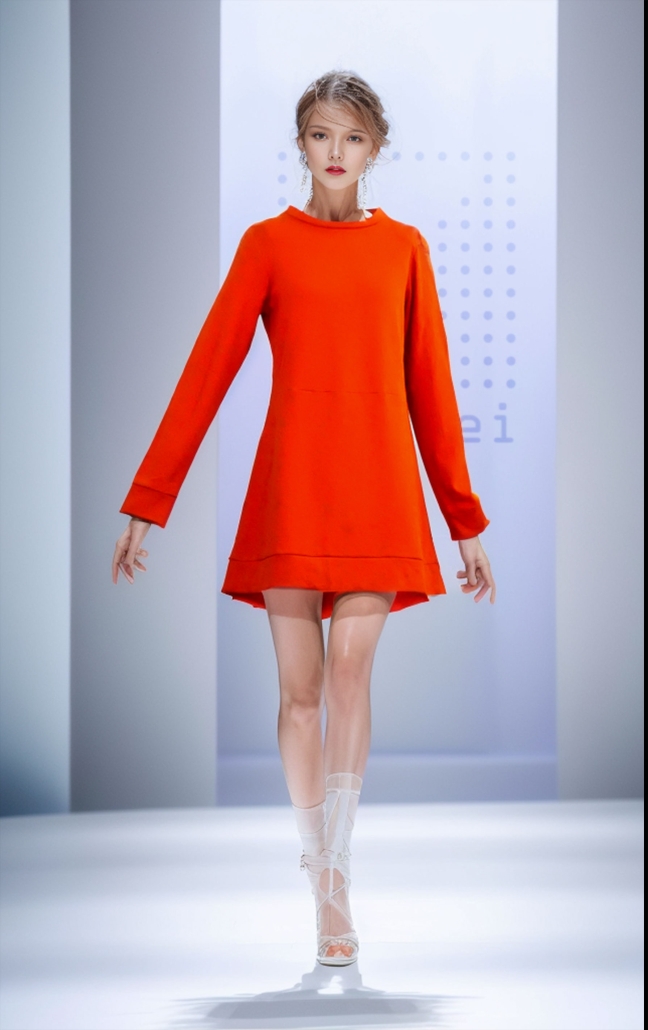
As a curious and forward-thinking designer, I have of course decided to dabble in this topic. What seems particularly important to me, in addition to the pure production of new ideas, is the fact that AI can also generate photos that could potentially replace photo shootings with new collections for the label. Photo shoots are often a big challenge, not only in terms of personnel but also financially. Models have to be cast and booked, a photographer has to be commissioned, hair and make-up specialists have to be found, and sometimes it also makes sense to bring in a stylist. All in all, a whole handful of professionals, who should not only all have time on the same day, but also have to be paid.
So I bravely tried out an AI. I dragged images photographed on a mannequin into the tool to generate models on a catwalk. The results sometimes still seem a bit wooden, for the lack of a better term, but I’m sure we’ll be able to achieve very exciting and much more realistic images in the future.
So will strenuous and expensive photo shoots soon be a thing of the past?
AI can be a good way to achieve a professional appearance with low cost. I see a lot of potential for young and small labels that don’t have large budgets. These tools won’t replace the organic nature of a real photo any time soon. In addition, you leave a lot of creative freedom to a program in which you can only intervene to a limited extent.
At this point I must also make it clear that the photos posted here, were subsequently edited using graphics programs to improve the result.
What is your opinion? Will AI become the new standard in fashion and soon completely replace classic photo shoots?
https://www.shakkei.at/wp-content/uploads/2023/10/weshop-Task-1526690-scaled.jpg25601610Shakkei-Adminhttps://www.shakkei.at/wp-content/uploads/2026/09/icon-white-300x300.pngShakkei-Admin2023-10-10 15:51:112023-10-10 15:51:11AI and new technologies in fashion – a fast-paced trend or the only realistic future?
On April 24, 2023, a performance entitled “Time out with Haiku” took place at the Shakkei Designstore.
What is a haiku?
A haiku is a Japanese short form poem. It always consists of 3 lines, with 5, 7 and 5 syllables. It is about describing a mood, a feeling or a phenomenon from nature. All haikus read during the performance were written by Gabriel Baradee. We would be happy to send you your favorite haiku.
https://www.shakkei.at/wp-content/uploads/2023/04/titel-1.jpg10801920Shakkei-Adminhttps://www.shakkei.at/wp-content/uploads/2026/09/icon-white-300x300.pngShakkei-Admin2023-04-05 13:13:192023-04-05 13:31:48Shakkei Performance at the Design Store
We use cookies that help us to enhance our website. If you are fine with that please click OK to confirm. You can learn more about our efforts to protect your data at our Privacy Policy.
We may request cookies to be set on your device. We use cookies to let us know when you visit our websites, how you interact with us, to enrich your user experience, and to customize your relationship with our website.
Click on the different category headings to find out more. You can also change some of your preferences. Note that blocking some types of cookies may impact your experience on our websites and the services we are able to offer.
Essential Website Cookies
These cookies are strictly necessary to provide you with services available through our website and to use some of its features.
Because these cookies are strictly necessary to deliver the website, refusing them will have impact how our site functions. You always can block or delete cookies by changing your browser settings and force blocking all cookies on this website. But this will always prompt you to accept/refuse cookies when revisiting our site.
We fully respect if you want to refuse cookies but to avoid asking you again and again kindly allow us to store a cookie for that. You are free to opt out any time or opt in for other cookies to get a better experience. If you refuse cookies we will remove all set cookies in our domain.
We provide you with a list of stored cookies on your computer in our domain so you can check what we stored. Due to security reasons we are not able to show or modify cookies from other domains. You can check these in your browser security settings.
Google Analytics Cookies
These cookies collect information that is used either in aggregate form to help us understand how our website is being used or how effective our marketing campaigns are, or to help us customize our website and application for you in order to enhance your experience.
If you do not want that we track your visit to our site you can disable tracking in your browser here:
Other external services
We also use different external services like Google Webfonts, Google Maps, and external Video providers. Since these providers may collect personal data like your IP address we allow you to block them here. Please be aware that this might heavily reduce the functionality and appearance of our site. Changes will take effect once you reload the page.
Google Webfont Settings:
Google Map Settings:
Google reCaptcha Settings:
Vimeo and Youtube video embeds:
Other cookies
The following cookies are also needed - You can choose if you want to allow them: